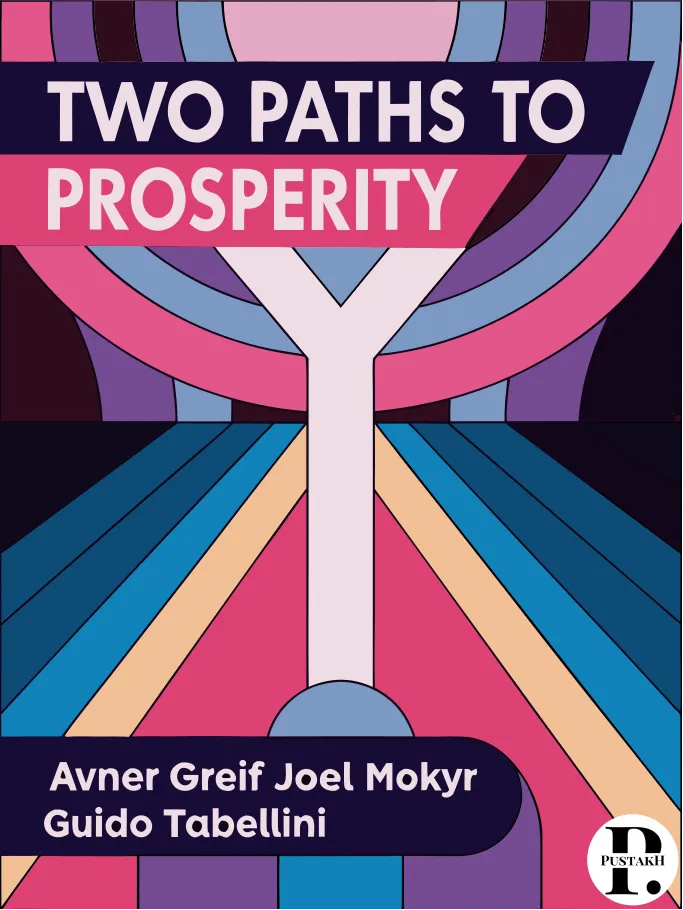
Two Paths to Prosperity
by Avner Greif, Joel Mokyr & Guido Tabellini
Culture and Institutions in Europe and China, 1000–2000
9
Chapters
69+
Action steps
12
Minutes
PERSONALIZED
Action steps tailored to your goals in the Pustakh app
Preview — Chapter 01: The Great Divergence
The idea of the “great divergence” becomes far more interesting when you realize that Europe and China began with remarkably similar strengths - large populations, vibrant cities, advanced technologies, and bustling markets. Yet over time, their paths drifted apart. Europe pushed toward fragmentation, competition, and experimentation, while China reinforced unity, hierarchy, and continuity. Both approaches worked, but only one nurtured the messy, unpredictable environment where innovation flourishes. What truly set Europe apart wasn’t geography or intelligence but the growing presence of institutions that rewarded risk-taking. Merchant guilds sprang up. City-states competed. Corporations and chartered companies emerged. Legal systems evolved to protect entrepreneurs. People were increasingly able to build collaborations beyond kinship, and that social flexibility widened the possibilities for trade, exploration, and scientific discovery. Meanwhile, China excelled at building order - an extraordinary achievement - yet that very strength sometimes slowed its ability to reinvent itself. The state remained powerful, kinship ties deep, and the bureaucracy immensely skilled but resistant to disruptive shifts. Over centuries, small differences compounded, nudging Europe and China toward dramatically different futures. What feels most striking is how subtle the early differences were - and how enormous their long-term consequences became.
Keep reading on PustakhYou've read the opening. Here's where it gets practical.
The remaining 8 chapters, the full audio summary, and 69+ action steps personalized to your goals unlock with a free 3-day trial.
Start free 3-day trialNo credit card required · Cancel anytime
Two Paths to Prosperity summary — FAQ
What will I get from the Two Paths to Prosperity summary on Pustakh?
The key ideas of "Two Paths to Prosperity" by Avner Greif, Joel Mokyr & Guido Tabellini, distilled into a roughly 15-minute read across 9 chapters, plus 69+ personalized action steps built around your goals and an optional audio version.
How long does the Two Paths to Prosperity summary take?
About 12 minutes to read the full summary on Pustakh, or you can listen to the audio version.
Does Two Paths to Prosperity have an audio summary?
Select Pustakh titles include audio summaries you can play in your browser, and new audio titles are added every week.
Is the Two Paths to Prosperity summary free?
You can read the introduction to "Two Paths to Prosperity" for free. Full access to every chapter and your personalized action steps is included with a Pustakh subscription. New accounts start with a free 3-day trial — no credit card required.
More Learning & Skill Development summaries
View all
12 Books That Changed the World
by Melvyn Bragg
21 Lessons for the 21st Century
by Yuval Noah Harari
Actionable Gamification
by Yu-kai Chou
A Mind for Numbers
by Barbara Oakley
A Short History of Nearly Everything
by Bill Bryson
Build, Don’t Talk
by Raj Shamani
69+ action steps from Two Paths to Prosperity, tailored to your goals in Pustakh
- Tailored to your context and what you are working on
- Personalized steps per chapter, not generic checklists
- Read and listen on your schedule—then act with clarity
- Unlock the full library with a simple subscription
We'll set it up as we learn what you're working on.