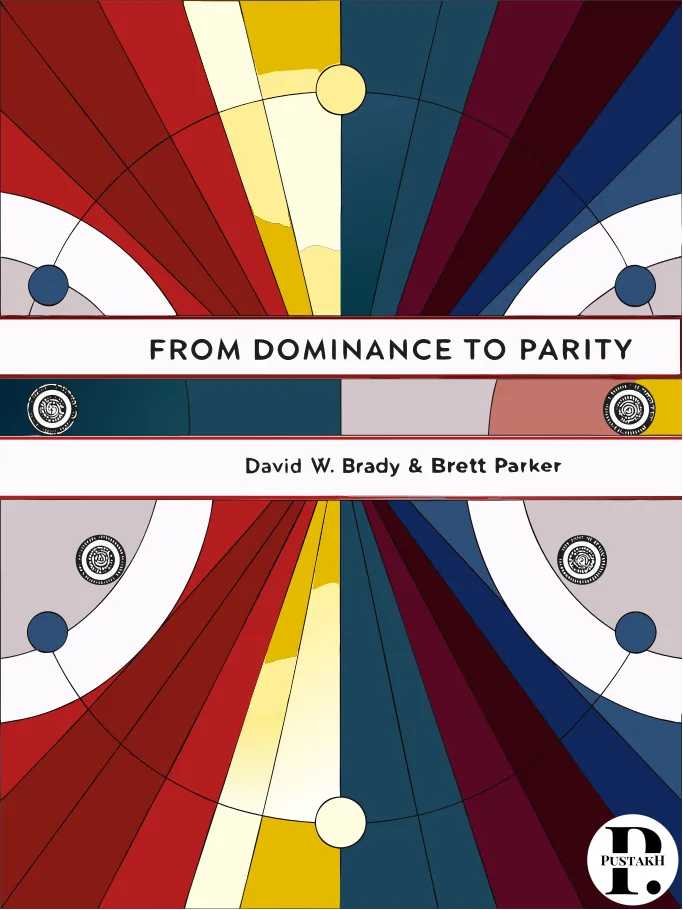
From Dominance to Parity
by David W. Brady & Brett Parker
America’s Political Parties and the New Era of Electoral Instability
6
Chapters
47+
Action steps
10
Minutes
PERSONALIZED
Action steps tailored to your goals in the Pustakh app
Preview — Chapter 01: Mass Partisanship from Roosevelt to Trump
Across the 20th century, America’s political story can be traced through its emotional attachment to parties. Partisanship once functioned like family loyalty, passed down, rarely questioned, and deeply personal. From the New Deal to the Reagan Revolution, each generation believed its political identity mirrored its moral compass. The party wasn’t merely a platform; it was a tribe. During Franklin Roosevelt’s era, mass partisanship forged stability. The Democrats’ New Deal coalition united workers, minorities, and intellectuals under the promise of shared prosperity. The Republican counteridentity, grounded in business, tradition, and local control, provided contrast but rarely chaos. People voted by habit, not volatility. Politics was a ritual more than a revolution. That unity began to crack with the Civil Rights Movement, Vietnam, and cultural upheavals of the 60s and 70s. Moral questions invaded economic debates. The South flipped allegiance. By the 1990s, media fragmentation turned political identity into performance. Cable news and talk radio offered echo chambers that rewarded outrage over nuance. By the Trump era, partisanship no longer required belief in policy, only belonging to a side. The age of loyalty became the age of resentment. The new partisan divide wasn’t about what people wanted government to do but whom they wanted it to hurt, help, or silence. Yet this fragmentation also signaled democratization, more voices, more issues, and more participation, even if chaotic. Understanding this evolution is key to seeing how a culture built on loyalty transitioned to one sustained by perpetual combat, where emotion replaced ideology, and politics became the new religion of belonging.
Keep reading on PustakhYou've read the opening. Here's where it gets practical.
The remaining 5 chapters, the full audio summary, and 47+ action steps personalized to your goals unlock with a free 3-day trial.
Start free 3-day trialNo credit card required · Cancel anytime
From Dominance to Parity summary — FAQ
What will I get from the From Dominance to Parity summary on Pustakh?
The key ideas of "From Dominance to Parity" by David W. Brady & Brett Parker, distilled into a roughly 15-minute read across 6 chapters, plus 47+ personalized action steps built around your goals and an optional audio version.
How long does the From Dominance to Parity summary take?
About 10 minutes to read the full summary on Pustakh, or you can listen to the audio version.
Does From Dominance to Parity have an audio summary?
Select Pustakh titles include audio summaries you can play in your browser, and new audio titles are added every week.
Is the From Dominance to Parity summary free?
You can read the introduction to "From Dominance to Parity" for free. Full access to every chapter and your personalized action steps is included with a Pustakh subscription. New accounts start with a free 3-day trial — no credit card required.
More Learning & Skill Development summaries
View all
12 Books That Changed the World
by Melvyn Bragg
21 Lessons for the 21st Century
by Yuval Noah Harari
Actionable Gamification
by Yu-kai Chou
A Mind for Numbers
by Barbara Oakley
A Short History of Nearly Everything
by Bill Bryson
Build, Don’t Talk
by Raj Shamani
47+ action steps from From Dominance to Parity, tailored to your goals in Pustakh
- Tailored to your context and what you are working on
- Personalized steps per chapter, not generic checklists
- Read and listen on your schedule—then act with clarity
- Unlock the full library with a simple subscription
We'll set it up as we learn what you're working on.