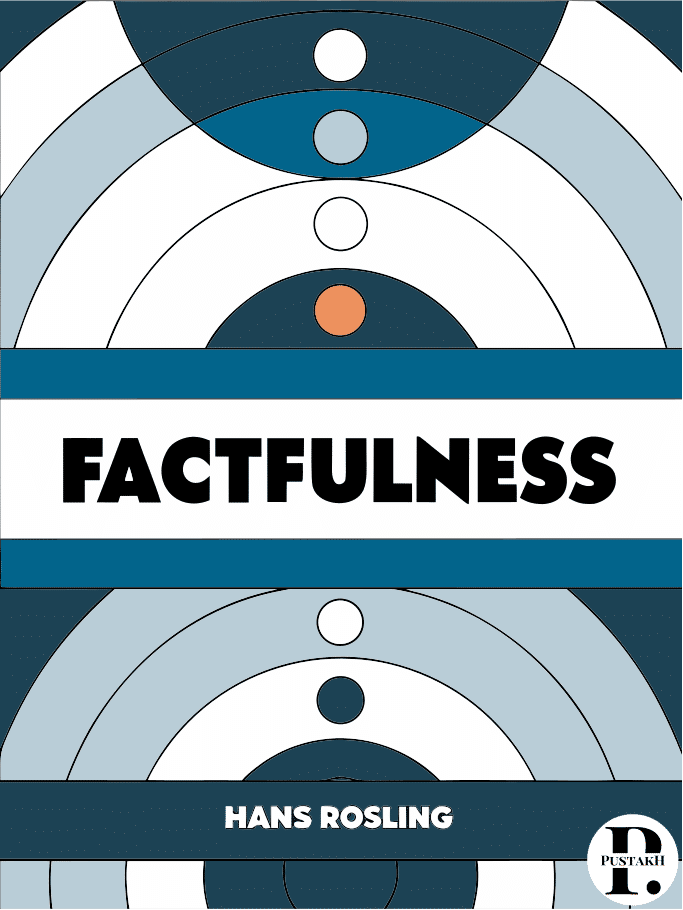
Factfulness
by Hans Rosling
Ten Reasons We're Wrong About the World - and Why Things are Better Than You Think
11
Chapters
82+
Action steps
15
Minutes
PERSONALIZED
Action steps tailored to your goals in the Pustakh app
Preview — Chapter 01: The Gap Instinct - Why We Divide the World Into "Us" and "Them"
The gap instinct is one of the most stubborn traps the human mind falls into. It convinces us that the world is divided neatly into two categories: the rich versus the poor, the advanced versus the primitive, the fortunate versus the desperate. This binary mindset is appealing because it simplifies complexity. It offers a story of contrast, where one side is comfortable and the other is struggling. But the truth doesn’t match this black-and-white narrative. Reality exists on a spectrum. Instead of two separate blocks, humanity spreads across a wide range of living standards. Billions of people live somewhere in the middle, where progress is steady but not glamorous. Families may not have luxury cars, but they cook with gas instead of firewood. They may not live in skyscrapers, but their children attend schools with books and pencils. Yet because the media and outdated education focus on extremes, the middle disappears from our mental picture. The danger of the gap instinct is that it blinds us to the overlap and similarities that connect people across nations. A family in Nairobi might share more in common with a family in São Paulo than either realizes: morning alarms, kids rushing to catch buses, parents worrying about groceries, neighbors chatting on the street. When we assume an unbridgeable gap, we exaggerate differences and fuel stereotypes. This instinct also has political consequences. It shapes policies and aid programs built on the assumption that entire nations are trapped in poverty, when in fact they are moving forward, often rapidly. It leads to misplaced pity rather than productive collaboration. Worse, it convinces us that progress is impossible because the “poor world” is permanently stuck at the bottom. To fight this instinct, we need a new lens. Instead of asking, “Which side of the gap is this country on?” we should ask, “Where on the spectrum is this country, and how is it moving?” Thinking in terms of levels, not categories, breaks the illusion of two worlds. This approach acknowledges progress while also highlighting remaining challenges. The gap instinct feeds on outdated labels, but reality is filled with nuance. By replacing binary thinking with gradients, we uncover a world where billions of lives are improving. The so-called “others” are not a separate group at all - they are part of the same continuum, moving in the same direction.
Keep reading on PustakhYou've read the opening. Here's where it gets practical.
The remaining 10 chapters, the full audio summary, and 82+ action steps personalized to your goals unlock with a free 3-day trial.
Start free 3-day trialNo credit card required · Cancel anytime
Factfulness summary — FAQ
What will I get from the Factfulness summary on Pustakh?
The key ideas of "Factfulness" by Hans Rosling, distilled into a roughly 15-minute read across 11 chapters, plus 82+ personalized action steps built around your goals and an optional audio version.
How long does the Factfulness summary take?
About 15 minutes to read the full summary on Pustakh, or you can listen to the audio version.
Does Factfulness have an audio summary?
Select Pustakh titles include audio summaries you can play in your browser, and new audio titles are added every week.
Is the Factfulness summary free?
You can read the introduction to "Factfulness" for free. Full access to every chapter and your personalized action steps is included with a Pustakh subscription. New accounts start with a free 3-day trial — no credit card required.
More Learning & Skill Development summaries
View all
12 Books That Changed the World
by Melvyn Bragg
21 Lessons for the 21st Century
by Yuval Noah Harari

Actionable Gamification
by Yu-kai Chou
A Mind for Numbers
by Barbara Oakley

A Short History of Nearly Everything
by Bill Bryson
Build, Don’t Talk
by Raj Shamani
82+ action steps from Factfulness, tailored to your goals in Pustakh
- Tailored to your context and what you are working on
- Personalized steps per chapter, not generic checklists
- Read and listen on your schedule—then act with clarity
- Unlock the full library with a simple subscription
We'll set it up as we learn what you're working on.