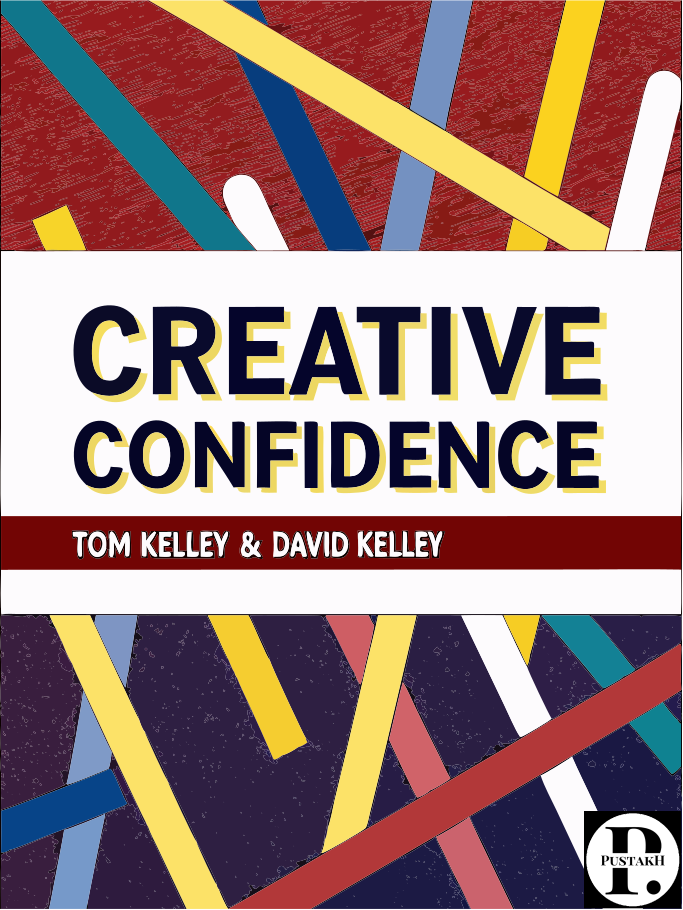
Creative Confidence
by Tom Kelley & David Kelley
Unleashing the Creative Potential Within Us All
8
Chapters
75+
Action steps
24
Minutes
PERSONALIZED
Action steps tailored to your goals in the Pustakh app
Preview — Chapter 01: Flip - From Design Thinking to Creative Confidence
In almost every industry, there are people quietly holding themselves back, not because they lack intelligence or ambition, but because they’ve labeled themselves “not creative.” They might be skilled analysts, managers, doctors, engineers, or educators, yet the word “creative” feels off-limits. Somewhere in childhood or early adulthood, they were taught that creativity belonged to a special class of people, the artists, the writers, the visionary types. Everyone else? Stay in your lane. That belief becomes a self-fulfilling prophecy. Once creativity is ruled out, people stop trying new things, avoid taking risks, and reject ideas before they even have a chance to breathe. The result? Innovation stalls. Progress slows. And brilliant ideas never see the light of day, not because they weren’t good, but because they weren’t voiced. The shift begins when people stop seeing creativity as a talent and start seeing it as a way of approaching problems, with openness, empathy, and experimentation. That’s where the concept of design thinking enters. Often misunderstood as a buzzword or a process for designers alone, design thinking is really a mindset, a flexible, human-centered approach to solving problems that applies to nearly every field and role. Design thinking is built on five key stages: empathize, define, ideate, prototype, and test. It begins by deeply understanding people’s needs, not just their stated problems. From there, the process invites brainstorming without judgment, encourages rapid prototyping (even if it’s messy), and values feedback over perfection. It transforms problem-solving from something static and linear into something dynamic and iterative. Real-world stories show just how transformative this mindset can be. A doctor used design thinking to completely rethink the patient intake experience, making it more comforting and less bureaucratic. A nonprofit team redesigned how food banks distribute meals, increasing efficiency and dignity. A high school teacher co-created a new grading system with her students to boost engagement. None of these people considered themselves “creative” in the traditional sense, but all of them learned to think like designers. And by doing so, they created lasting change. The real magic lies in the flip. Once someone realizes they’re allowed to be creative, they begin to see opportunities where they once saw roadblocks. They speak up in meetings. They sketch ideas on napkins. They test new approaches without waiting for permission. They take ownership of problems instead of working around them. But the shift isn’t just external, it’s internal. It’s about trading fear for action. Instead of overthinking or seeking the “perfect” solution, people start experimenting. Instead of staying stuck in planning mode, they build. And every small experiment builds creative confidence, the belief that you can create meaningful change. Creativity thrives not in moments of inspiration, but in moments of courage. And courage comes when you’re willing to flip the script: from self-doubt to self-starting. From hesitation to iteration. From “I’m not creative” to “Let’s see what happens.”
Keep reading on PustakhYou've read the opening. Here's where it gets practical.
The remaining 7 chapters, the full audio summary, and 75+ action steps personalized to your goals unlock with a free 3-day trial.
Start free 3-day trialNo credit card required · Cancel anytime
Creative Confidence summary — FAQ
What will I get from the Creative Confidence summary on Pustakh?
The key ideas of "Creative Confidence" by Tom Kelley & David Kelley, distilled into a roughly 15-minute read across 8 chapters, plus 75+ personalized action steps built around your goals and an optional audio version.
How long does the Creative Confidence summary take?
About 24 minutes to read the full summary on Pustakh, or you can listen to the audio version.
Does Creative Confidence have an audio summary?
Yes. "Creative Confidence" includes an audio summary you can listen to directly in your browser — no separate app required.
Is the Creative Confidence summary free?
You can read the introduction to "Creative Confidence" for free. Full access to every chapter and your personalized action steps is included with a Pustakh subscription. New accounts start with a free 3-day trial — no credit card required.
More Creativity & Innovation summaries
View all



75+ action steps from Creative Confidence, tailored to your goals in Pustakh
- Tailored to your context and what you are working on
- Personalized steps per chapter, not generic checklists
- Read and listen on your schedule—then act with clarity
- Unlock the full library with a simple subscription
We'll set it up as we learn what you're working on.